

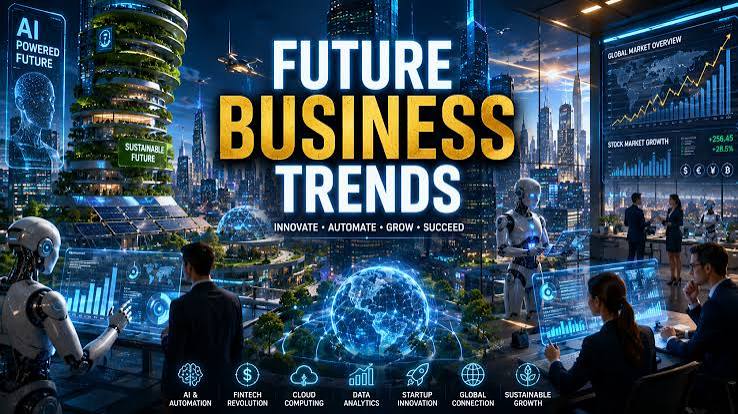
Future Business Trends Changing the Global Market are reshaping how companies compete, invest, hire, sell, and manage risk. Artificial intelligence, automation, digital commerce, energy transition, cybersecurity, demographic change, and shifting trade patterns are influencing business decisions across industries and regions.
This article explains trends likely to shape global business in the coming years, why they matter, and how companies can respond. It focuses on implications for strategy, workforce planning, technology adoption, supply chains, customer expectations, sustainability, and long-term global competitiveness.
Why Global Business Is Changing Faster
Companies are operating in an environment shaped by simultaneous technological, economic, demographic, environmental, and geopolitical change.
The World Economic Forum identifies technological change, geoeconomic fragmentation, economic uncertainty, demographic shifts, and the green transition among the major forces expected to transform businesses and labor markets through 2030.
These trends are connected.
Artificial intelligence can change productivity and staffing requirements. Energy investment can influence manufacturing and infrastructure. Trade tensions can alter sourcing decisions. Population changes can affect labor availability and consumer demand.
Businesses therefore need to monitor several trends rather than planning around one isolated development.
Read More: How Successful Businesses Build Customer Loyalty
1. Artificial Intelligence Is Becoming a Core Business Capability
Artificial intelligence is moving beyond experimentation and becoming part of routine business operations.
Companies are increasingly exploring AI for customer service, software development, marketing, forecasting, analytics, fraud detection, document processing, product design, and internal knowledge management.
The World Economic Forum’s Future of Jobs Report found that 86% of surveyed employers expected AI and information-processing technologies to transform their businesses by 2030.
The important shift is not simply that businesses will “use AI.”
Competitive advantage will increasingly depend on how effectively organizations integrate AI into real workflows.
AI Will Change How Work Is Organized
Many business processes contain a combination of repetitive and judgment-based tasks.
AI can handle or assist with some activities while employees remain responsible for decisions requiring context, accountability, creativity, negotiation, or human interaction.
For example, a sales team might use AI to summarize customer conversations and identify opportunities while sales representatives manage relationships and negotiate contracts.
A finance department might automate document classification but retain human oversight for financial decisions.
Businesses should therefore evaluate individual tasks rather than assuming entire occupations will simply disappear.
2. Automation Will Expand Beyond Factories
Automation has traditionally been associated with manufacturing.
That definition is becoming much broader.
Software automation, robotics, autonomous systems, AI agents, and connected machinery can increasingly support activities in logistics, agriculture, retail, construction, healthcare, administration, and professional services.
The World Economic Forum reports that 58% of surveyed employers expected robotics and automation to be transformative by 2030.
For businesses, automation can potentially improve consistency, productivity, speed, and scalability.
However, automation also requires investment in process redesign, cybersecurity, integration, maintenance, and employee skills.
The strongest automation opportunities are usually processes that are repetitive, high-volume, measurable, and sufficiently standardized.
3. Workforce Skills Will Become a Major Competitive Factor
Technology adoption does not create value automatically.
Companies need employees capable of using new systems effectively.
The Future of Jobs Report 2025 found strong expected growth in demand for technology skills alongside human capabilities such as cognitive skills and collaboration.
This creates a strategic challenge.
Businesses may find that buying software is easier than finding or developing employees who know how to use it productively.
Future workforce planning is therefore likely to place greater emphasis on:
- AI and data literacy
- Cybersecurity awareness
- Analytical thinking
- Adaptability
- Problem-solving
- Communication
- Leadership
- Digital collaboration
Companies that continuously reskill employees may be better positioned to adopt new technologies without constantly replacing existing teams.
4. Hybrid Human-AI Workflows Will Become Normal
The future workplace is unlikely to be divided neatly between work performed entirely by humans and work performed entirely by machines.
Many organizations will instead operate hybrid workflows.
A marketing professional may use AI for initial research but make the final positioning decisions.
A programmer may use coding assistance while remaining responsible for architecture, security, and testing.
A customer-service employee may receive AI-generated suggested responses but determine how to handle unusual cases.
This model allows businesses to combine machine speed with human judgment.
The critical management question will shift from:
“Can AI do this job?”
to:
“Which parts of this workflow should be automated, assisted, reviewed, or kept entirely human?”
5. Digital Commerce Will Continue Expanding
Digital commerce is becoming increasingly integrated into the global economy.
UN Trade and Development reported that business e-commerce sales across 43 economies representing roughly three-quarters of global GDP reached about $27 trillion in 2022.
The broader trend is important even for businesses that do not consider themselves ecommerce companies.
Digital buying behavior affects:
- Product research
- Business-to-business procurement
- Customer support
- Payments
- subscriptions
- cross-border sales
- marketplace participation
Customers increasingly move between websites, marketplaces, mobile applications, messaging platforms, and physical locations.
Successful businesses will need to make those experiences feel connected.
6. Digital Payments Will Expand Market Access
Digital payments are becoming an increasingly important part of global commerce.
The World Bank’s Global Findex 2025 provides updated data covering financial services, payments, internet access, mobile-phone ownership, and digital safety across 141 economies.
For businesses, broader digital financial participation can create opportunities in markets where traditional banking infrastructure has historically limited commerce.
This can support growth in areas such as ecommerce, subscriptions, digital services, online marketplaces, fintech, and cross-border business.
However, expansion also increases the importance of fraud prevention, privacy, identity verification, and payment security.
7. Cybersecurity Is Becoming a Board-Level Business Issue
Cybersecurity is no longer simply an IT department responsibility.
Digital operations now affect payments, supply chains, customer databases, cloud infrastructure, communications, manufacturing systems, and intellectual property.
The World Economic Forum’s Global Cybersecurity Outlook 2026 describes AI adoption, geopolitical fragmentation, and complex supply chains as major factors reshaping global cyber risk.
The same report found that 87% of respondents identified AI-related vulnerabilities as the fastest-growing cyber risk during 2025.
Businesses therefore need to treat cybersecurity as a strategic resilience issue.
That includes protecting systems, training employees, evaluating suppliers, creating incident-response plans, and assessing risks associated with new AI tools.
8. Supply-Chain Resilience Will Matter More Than Lowest Cost Alone
For decades, many companies optimized supply chains primarily around cost and efficiency.
Recent disruptions have shown the risks of depending heavily on a limited number of suppliers, markets, shipping routes, or regions.
The WTO continues to identify geopolitical tensions, global value chains, digitalization, government interventions, and economic fragmentation as major forces affecting international trade.
This does not mean globalization is ending.
It means companies may increasingly balance efficiency with resilience.
Businesses may respond by diversifying suppliers, carrying strategic inventory, developing alternative transportation routes, improving supply-chain visibility, or sourcing critical components from multiple regions.
9. Geopolitical Fragmentation Will Influence Business Strategy
International business decisions are increasingly affected by geopolitics.
Trade restrictions, tariffs, industrial policy, technology controls, sanctions, energy security, and strategic competition can alter operating conditions quickly.
The WTO’s 2026 World Trade Report warns that deeper fragmentation of the global trading system could create significant economic costs.
For companies operating internationally, political risk analysis is therefore becoming more closely connected with commercial strategy.
Businesses may need to examine where products are manufactured, where data is stored, which technologies they depend on, and whether critical suppliers are concentrated in politically sensitive regions.
10. Regionalization Will Influence Global Supply Networks
Globalization and regionalization can occur simultaneously.
Companies can continue selling globally while reorganizing production around regional hubs.
A company serving customers in North America, Europe, and Asia might maintain regional manufacturing, logistics, or data infrastructure rather than operating through one centralized system.
This can reduce transportation exposure and increase responsiveness to local regulation or customer demand.
However, regionalization can also increase complexity and operating costs.
Businesses will need to determine which activities benefit from global scale and which benefit from geographic diversification.
11. The Energy Transition Will Create New Investment Opportunities
Energy systems are undergoing major investment changes.
The International Energy Agency estimated total global energy investment at approximately $3.3 trillion in 2025, with about $2.2 trillion directed toward areas including renewables, nuclear, electricity grids, storage, efficiency, low-emissions fuels, and electrification.
This shift affects more than energy companies.
Industries connected with batteries, transportation, construction, manufacturing, minerals, engineering, software, infrastructure, financing, and industrial efficiency can all be influenced by changing energy systems.
Businesses should therefore view the energy transition as both a compliance issue and a potential commercial opportunity.
12. Energy Security Will Become More Important
Sustainability is not the only force behind energy investment.
Energy security has become strategically important for governments and companies.
Businesses increasingly need to consider electricity reliability, fuel availability, energy prices, and dependence on specific suppliers.
This can encourage investment in efficiency, energy storage, distributed generation, renewable power agreements, and more resilient infrastructure.
Companies with energy-intensive operations may also treat energy strategy as part of long-term cost management.
13. Sustainable Business Models Will Receive More Attention
Businesses are under increasing pressure to consider environmental impacts across products, logistics, operations, packaging, and digital infrastructure.
UNCTAD’s Digital Economy Report highlights the significant material and energy requirements associated with expanding digital technologies and calls for greater emphasis on circularity, durable products, reuse, recycling, and lower-impact business models.
This creates opportunities for businesses focused on:
repairability, recycling, energy efficiency, sustainable packaging, product longevity, low-carbon logistics, and resource optimization.
Companies should avoid treating sustainability entirely as a marketing message.
Environmental claims should be specific, measurable, and supported by actual practices.
14. Circular Economy Models May Expand
Traditional business models often follow a linear pattern:
produce, sell, use, discard.
Circular models attempt to retain value for longer through repair, refurbishment, resale, recycling, reuse, or product-as-a-service arrangements.
This trend can influence industries such as electronics, fashion, automotive, industrial machinery, packaging, and construction.
Potential business opportunities include refurbished products, take-back programs, resale marketplaces, repair services, reusable packaging, and materials recovery.
The viability of each model depends on product economics, regulation, logistics, and customer demand.
15. Demographic Change Will Reshape Markets
Population structures are changing differently across regions.
Some countries are experiencing ageing populations and slower labor-force growth, while others have younger and rapidly expanding populations.
The International Labour Organization notes that population ageing is affecting labor markets globally, while its 2026 employment report highlights significant differences in labor-force dynamics across income groups.
These changes can reshape both labor supply and consumer demand.
Ageing economies may create growth opportunities in healthcare, financial services, assisted living, accessibility technology, leisure, and age-friendly products.
Younger economies may experience stronger demand for education, housing, digital services, financial products, employment, and consumer goods.
16. Talent Shortages Will Push Companies Toward New Workforce Models
In regions with ageing populations or shortages of particular skills, businesses may find recruitment increasingly difficult.
Possible responses include remote hiring, automation, employee training, flexible schedules, international recruitment, and redesigning jobs.
Companies may also need to improve retention.
Constantly replacing experienced workers can become expensive when specialized skills are scarce.
Workforce strategy will therefore involve both attracting talent and improving productivity among existing employees.
17. Remote and Distributed Work Will Remain Important
The future of work is unlikely to involve a universal return to one working model.
Different jobs require different levels of physical presence.
Manufacturing and healthcare may require substantial onsite work, while software, consulting, design, administration, and other knowledge functions may support more distributed models.
This means businesses will increasingly design work around tasks rather than broad assumptions.
Distributed teams can expand access to talent, but they also require strong systems for communication, security, performance management, documentation, and organizational culture.
18. Consumer Expectations Will Become More Personalized
Digital platforms have increased customer expectations around relevance and convenience.
Customers increasingly expect businesses to remember preferences, provide fast service, offer relevant recommendations, and maintain consistent experiences across channels.
AI can make personalization more sophisticated.
However, personalization should not become intrusive.
Businesses need to balance relevance with privacy, transparency, and responsible data use.
The most useful personalization reduces customer effort rather than simply displaying more targeted advertising.
19. Customers Will Expect Faster Service
Digital commerce has changed expectations around response times.
Customers accustomed to real-time notifications, online ordering, instant account access, and automated support may become less tolerant of unnecessary delays.
This does not mean every company must provide service every minute of the day.
Instead, businesses should remove avoidable friction.
Self-service tools, automation, better information, online scheduling, digital payments, and clear status updates can make businesses feel faster without requiring employees to be constantly available.
20. Subscription and Recurring-Revenue Models Will Continue Evolving
Subscriptions are already common in software, entertainment, media, consumer goods, professional services, and membership businesses.
Recurring revenue can improve revenue predictability, but customers are becoming more selective about subscriptions.
Future subscription businesses will need to demonstrate continuing value.
Weak subscriptions that depend on customers forgetting to cancel are unlikely to create strong loyalty.
Successful recurring-revenue models should make renewal feel worthwhile through convenience, ongoing service, exclusive benefits, useful content, or regularly delivered value.
21. Business Models Will Become More Service-Oriented
Some companies traditionally focused on selling physical products are adding recurring services.
A manufacturer might add monitoring, maintenance, software, financing, or analytics.
A hardware company might sell equipment alongside subscription-based management tools.
This can deepen customer relationships and diversify revenue.
However, service-based revenue also requires different capabilities, including customer support, software operations, billing systems, and long-term account management.
22. Data Will Become More Valuable—and More Regulated
Business decisions increasingly depend on data.
Companies use data for forecasting, customer segmentation, fraud detection, personalization, inventory management, pricing, and operational efficiency.
At the same time, data collection creates responsibilities.
Organizations may face requirements involving privacy, data storage, cybersecurity, consent, retention, and cross-border transfers.
Future competitive advantage will therefore depend not only on collecting data but also on managing it responsibly.
Businesses that maintain accurate, well-governed data may also receive better results from AI systems.
23. Small Businesses Will Gain Access to More Advanced Technology
Cloud software, AI tools, ecommerce platforms, automation systems, and digital payment infrastructure can give smaller companies access to capabilities once available mainly to large enterprises.
A small business can now use sophisticated customer relationship management, analytics, automation, design, global payments, and online advertising without building those systems internally.
This lowers some barriers to competition.
However, access to technology does not guarantee success.
Small businesses still need clear positioning, strong execution, customer trust, and disciplined financial management.
24. Digital Infrastructure Will Become More Strategically Important
Modern business increasingly depends on cloud computing, data centers, communications networks, payment systems, and digital platforms.
As dependence increases, outages can produce larger operational consequences.
UNCTAD notes that the expansion of data processing, storage, AI, connectivity, and other digital technologies also creates significant energy and resource demands.
Businesses will therefore need to consider both the resilience and environmental footprint of digital infrastructure.
25. Emerging Markets Will Create New Growth Opportunities
Global growth opportunities are not distributed evenly.
Population growth, urbanization, digital adoption, infrastructure development, and expanding financial access can create new markets in emerging economies.
Businesses entering these markets should not simply copy strategies developed for mature economies.
Successful expansion often requires adapting:
pricing, payment methods, distribution, language, product design, customer support, and marketing.
Local partnerships can also be important where companies lack market knowledge.
26. Business Resilience Will Become a Competitive Advantage
Recent years have demonstrated how quickly businesses can face unexpected disruption.
Future resilience planning should cover multiple risks rather than focusing on one scenario.
Potential areas include technology failures, cyber incidents, supplier disruption, energy shortages, regulatory change, extreme weather, labor shortages, and geopolitical events.
Resilience does not mean eliminating all risk.
It means building an organization capable of continuing critical operations, adapting quickly, and recovering effectively.
How Major Business Trends Compare
| Trend | Main Business Impact | Strategic Response |
|---|---|---|
| Artificial intelligence | Productivity and workflow redesign | Integrate AI into valuable processes |
| Automation | Lower manual workload and greater scale | Automate repeatable tasks selectively |
| Skills transformation | Changing employee requirements | Invest in continuous reskilling |
| Digital commerce | More online and cross-border activity | Improve digital sales channels |
| Cybersecurity | Higher operational and financial risk | Build organization-wide cyber resilience |
| Supply-chain shifts | Greater sourcing uncertainty | Diversify critical suppliers |
| Energy transition | New costs and opportunities | Improve efficiency and assess energy strategy |
| Demographic change | Different workforce and consumer needs | Adapt products and talent strategy |
| Data regulation | Greater compliance responsibility | Improve governance and privacy controls |
| Geopolitical fragmentation | Trade and investment uncertainty | Build geographic and supplier flexibility |
How Businesses Can Prepare for Future Market Changes
Businesses do not need to chase every trend.
A better approach is to identify which trends materially affect customers, costs, workforce, technology, supply chains, or regulation.
Companies should review their assumptions regularly.
A strategy created for today’s market may become less effective when technology, customer expectations, or operating costs change.
The most resilient organizations tend to combine long-term direction with short-term adaptability.
They test new technologies before scaling them, monitor customer behavior, develop employee skills, strengthen critical suppliers, and maintain financial flexibility.
Which Trends Matter Most for Small Businesses?
Small businesses should prioritize trends based on direct business impact.
For many smaller companies, the most immediate areas may be AI-enabled productivity, digital payments, ecommerce, cybersecurity, automation, customer personalization, and changing acquisition channels.
A local service business probably does not need to create a dedicated geopolitical risk department.
However, it may need stronger cybersecurity, automated scheduling, better online payments, and AI-assisted administration.
The correct response depends on business size and exposure.
Which Trends Matter Most for Large Global Companies?
Multinational companies typically face broader complexity.
They may need to address supply-chain diversification, trade regulation, cross-border data rules, AI governance, workforce transformation, energy security, cybersecurity, and regional market strategies simultaneously.
Large organizations also face another challenge: implementation speed.
A small company may change software quickly.
A multinational business might need to coordinate thousands of employees, multiple regulatory environments, legacy systems, and complex procurement procedures.
Scale creates resources, but it also creates inertia.
Future Trends Should Not Be Treated as Guaranteed Predictions
Business forecasting always contains uncertainty.
Technology may develop more slowly or quickly than expected. Regulations may change. Economic conditions can shift. Consumer behavior may move in unexpected directions.
The IMF’s April 2026 World Economic Outlook emphasizes significant uncertainty around global growth, geopolitical fragmentation, trade tensions, and expectations surrounding AI-driven productivity.
Businesses should therefore avoid building strategies around one precise prediction.
Scenario planning is often more useful.
Companies can ask:
“What happens if this trend accelerates?”
“What happens if it develops slowly?”
“What happens if regulation changes?”
“What parts of our business are most exposed?”
This creates a more flexible strategy.
Frequently Asked Questions
What are the biggest future business trends?
Major trends include artificial intelligence, automation, digital commerce, cybersecurity, workforce transformation, changing demographics, supply-chain resilience, energy transition, data governance, and geopolitical fragmentation.
How will AI change the global business market?
AI can automate tasks, assist employees, improve analytics, personalize customer experiences, accelerate software development, and change how organizations structure work. Its business impact will depend on implementation quality, governance, data, security, and employee skills.
Will automation replace human workers?
Automation can replace or reduce some tasks while changing others and creating new requirements. Current research suggests significant job transformation rather than a simple one-directional replacement of all human work. Businesses will increasingly need combinations of technology skills and human capabilities.
Why are supply chains changing?
Companies are responding to geopolitical tensions, trade uncertainty, disruptions, transportation risks, and dependence on concentrated suppliers. Many are placing greater emphasis on resilience and diversification alongside cost efficiency.
How will sustainability affect future businesses?
Energy investment, resource efficiency, environmental regulation, consumer expectations, and circular-economy models can influence product design, supply chains, infrastructure, and investment decisions.
What industries may benefit from demographic change?
Potential opportunities can emerge in healthcare, financial services, housing, education, accessibility technology, consumer services, and other sectors depending on whether a region is ageing or experiencing younger population growth.
How can small businesses prepare for future trends?
Small businesses should prioritize trends directly affecting operations and customers. Practical areas may include adopting useful AI tools, improving cybersecurity, accepting digital payments, automating repetitive work, strengthening online visibility, and maintaining financial flexibility.
How should companies prepare for uncertainty?
Companies can use scenario planning, diversified supply chains, strong cash management, employee reskilling, cybersecurity controls, technology testing, and regular strategy reviews to reduce exposure to unexpected changes.
Conclusion
Future Business Trends Changing the Global Market are not driven by one technology or one economic shift. AI, automation, digitalization, changing trade patterns, cybersecurity, energy transformation, demographics, and evolving customer expectations are developing simultaneously.

1 Comment
Pingback: How the Digital World Is Changing Everyday Life