

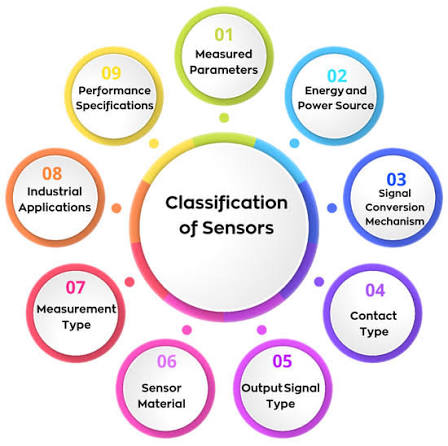
Types of Sensors and Actuators in IoT include devices that detect physical conditions and components that perform actions based on collected data. Sensors measure temperature, movement, pressure, light, humidity, and other environmental changes, while actuators convert digital commands into physical responses.
Together, sensors and actuators enable IoT systems to monitor surroundings, process information, and automate tasks. They are widely used in smart homes, healthcare, industrial automation, agriculture, connected vehicles, environmental monitoring, and smart cities.
What Are Sensors in IoT?
An IoT sensor is a device that detects or measures a physical condition and converts it into an electrical or digital signal. This signal can then be processed, stored, or transmitted to another connected system.
Depending on its purpose, a sensor may measure:
- Temperature
- Humidity
- Motion
- Pressure
- Light
- Sound
- Distance
- Location
- Air quality
- Soil moisture
The collected information is usually transmitted to a microcontroller, IoT gateway, edge device, or cloud platform. Software analyzes the data and determines whether an alert or automated response is required.
For example, a smart thermostat uses a temperature sensor to monitor room conditions. When the temperature falls outside the selected range, the system activates heating or cooling equipment.
Read More: Java Records in Java 16: Syntax, Features, and Examples
How Do Sensors Work in IoT?
IoT sensors generally work through the following process:
- The sensor detects a physical or environmental condition.
- It converts the measurement into an electrical or digital signal.
- A microcontroller or processing unit receives the signal.
- The data is transmitted through Wi-Fi, Bluetooth, Zigbee, cellular connectivity, or another communication protocol.
- Software analyzes the collected information.
- The system stores the data, generates an alert, or sends a command to an actuator.
This continuous flow of information allows connected devices to monitor their surroundings and respond in real time.
Common Types of Sensors in IoT
Different IoT applications require different sensing technologies. The following are some of the most commonly used IoT sensors.
1. Temperature Sensors
Temperature sensors detect heat levels and changes in temperature. They are commonly used in smart homes, industrial equipment, agriculture, healthcare facilities, food storage, and weather-monitoring systems.
Common temperature-sensing technologies include:
- Thermistors
- Thermocouples
- Resistance temperature detectors
- Semiconductor sensors
- Infrared temperature sensors
In factories, temperature sensors can identify overheating machinery before serious damage occurs. In cold-storage facilities, they help ensure that food and medicines remain within safe temperature limits.
2. Humidity Sensors
Humidity sensors measure the amount of moisture present in the air. They are often combined with temperature sensors to provide complete environmental monitoring.
Typical applications include:
- Smart heating and cooling systems
- Agricultural greenhouses
- Weather stations
- Warehouses
- Museums
- Healthcare facilities
- Data centers
Humidity monitoring helps prevent mold, protect sensitive equipment, and maintain suitable growing conditions for crops.
3. Pressure Sensors
Pressure sensors measure the force applied by liquids or gases. They are important in industrial automation, water management, medical equipment, aviation, and automotive systems.
They can monitor:
- Water pipelines
- Hydraulic systems
- Gas containers
- Vehicle tires
- Medical devices
- Manufacturing equipment
A sudden pressure drop inside a pipeline may indicate leakage, while unusually high pressure can warn operators about a potential system failure.
4. Proximity Sensors
Proximity sensors detect nearby objects without requiring physical contact. These sensors may use infrared light, electromagnetic fields, sound waves, or capacitive technology.
They are commonly found in:
- Automatic doors
- Parking assistance systems
- Smartphones
- Manufacturing lines
- Security systems
- Touchless controls
In a smart parking system, proximity sensors detect whether parking spaces are available and send that information to a mobile application or central platform.
5. Motion Sensors
Motion sensors detect movement within a particular area. Passive infrared sensors are widely used, but ultrasonic and microwave technologies are also available.
Common applications include:
- Security alarms
- Automatic lighting
- Smart cameras
- Occupancy monitoring
- Energy-management systems
- Elderly care solutions
A smart building can use motion sensors to turn off lights and reduce cooling when a room is unoccupied.
6. Light Sensors
Light sensors measure the intensity of natural or artificial light. They allow connected devices to adjust their operation according to surrounding lighting conditions.
They are used in:
- Automatic streetlights
- Smartphone displays
- Smart home lighting
- Greenhouses
- Solar energy systems
- Office automation
For example, a smart lighting system can reduce artificial light when sufficient daylight is available.
7. Gas and Air-Quality Sensors
Gas sensors detect particular gases or measure overall air quality. They are essential in environments where health, safety, or pollution monitoring is important.
These sensors may detect:
- Carbon monoxide
- Carbon dioxide
- Methane
- Smoke
- Ozone
- Volatile organic compounds
A smart air-quality system can notify occupants when pollution reaches an unsafe level and automatically activate ventilation equipment.
8. Sound Sensors
Sound sensors detect noise levels, vibrations, or particular audio patterns. Some measure general sound intensity, while advanced systems can identify particular events.
Common uses include:
- Noise pollution monitoring
- Security systems
- Industrial equipment monitoring
- Voice-controlled devices
- Glass-break detection
Changes in the sound produced by industrial machinery can sometimes indicate wear, imbalance, or mechanical failure.
9. Accelerometers
An accelerometer measures acceleration, movement, tilt, and orientation. It is frequently used in smartphones, wearable devices, vehicles, industrial equipment, and navigation systems.
Accelerometers support:
- Activity tracking
- Fall detection
- Screen rotation
- Vehicle movement analysis
- Equipment vibration monitoring
- Gesture recognition
Fitness trackers use accelerometers to estimate steps, movement patterns, and physical activity.
10. Gyroscope Sensors
Gyroscope sensors measure angular movement and rotational orientation. They are often combined with accelerometers for more accurate motion tracking.
Applications include:
- Drones
- Smartphones
- Gaming controllers
- Robotics
- Navigation equipment
- Vehicle stabilization systems
A drone uses gyroscope readings to maintain balance and adjust its position during flight.
11. Level Sensors
Level sensors measure the amount of liquid, powder, or granular material stored inside a container.
They are commonly used in:
- Water tanks
- Fuel containers
- Agricultural silos
- Chemical storage facilities
- Waste-management systems
- Manufacturing plants
A connected water tank can generate an alert when its level becomes too low or automatically stop a pump when the tank is full.
12. Soil-Moisture Sensors
Soil-moisture sensors determine the amount of water present in soil. They are an essential part of smart farming and automated irrigation systems.
These sensors help farmers:
- Prevent excessive watering
- Reduce water consumption
- Improve growing conditions
- Monitor fields remotely
- Schedule irrigation accurately
When the soil becomes too dry, the IoT system can automatically open an irrigation valve.
13. Image Sensors
Image sensors capture visual information through cameras. When combined with image-processing software or artificial intelligence, they can identify objects, people, defects, and unusual activities.
Common applications include:
- Smart surveillance
- Facial recognition
- Traffic management
- Medical imaging
- Quality inspection
- Agricultural monitoring
Manufacturing systems can use image sensors to detect damaged products before they reach customers.
14. Location and Position Sensors
Location sensors determine the geographic position or movement of an object. Technologies such as GPS, RFID, Bluetooth beacons, and ultra-wideband tracking may be used.
Applications include:
- Fleet management
- Delivery tracking
- Asset monitoring
- Navigation
- Supply-chain management
- Personal safety devices
A logistics company can use location sensors to monitor vehicles, optimize routes, and estimate delivery times.
What Are Actuators in IoT?
An actuator is an output device that converts an electrical control signal into a physical action. While sensors collect information, actuators perform the response selected by the IoT system.
An actuator may:
- Open or close a valve
- Start or stop a motor
- Lock or unlock a door
- Switch a light on or off
- Move a robotic arm
- Control heating equipment
- Produce sound or vibration
For example, when a soil-moisture sensor detects dry conditions, the IoT platform can command an actuator to open an irrigation valve.
How Do Actuators Work in IoT?
An actuator receives a command from a microcontroller, programmable logic controller, IoT gateway, or cloud-connected platform. It then converts electrical energy into movement, heat, pressure, sound, or another physical output.
The general process is:
- A sensor collects information.
- The system analyzes the data.
- Software determines the appropriate response.
- A command is sent to an actuator.
- The actuator performs the physical action.
- Sensors measure the updated conditions and provide feedback.
This process creates a closed-loop control system in which IoT devices continuously monitor and adjust their operations.
Common Types of Actuators in IoT
1. Electric Actuators
Electric actuators use electrical energy to create movement. They are accurate, easy to control, and widely used in smart devices and industrial systems.
Examples include:
- Electric motors
- Servo motors
- Stepper motors
- Solenoids
- Linear actuators
A smart curtain system may use an electric motor to open or close curtains according to the time, sunlight level, or a mobile application command.
2. Hydraulic Actuators
Hydraulic actuators use pressurized liquid to produce powerful mechanical movement. They are suitable for applications requiring considerable force.
They are commonly used in:
- Heavy machinery
- Construction equipment
- Industrial presses
- Manufacturing systems
- Agricultural machinery
Hydraulic actuators provide high force but require pumps, fluid lines, control valves, and regular maintenance.
3. Pneumatic Actuators
Pneumatic actuators use compressed air to create movement. They are fast, relatively simple, and useful in industrial environments.
Typical applications include:
- Packaging machines
- Assembly lines
- Robotic systems
- Air-powered valves
- Material-handling equipment
They are generally selected when fast and repeated movement is more important than highly precise positioning.
4. Thermal Actuators
Thermal actuators respond to changes in temperature or use heat to produce motion. Some depend on materials that expand and contract, while others use shape-memory alloys.
They are used in:
- Temperature-control systems
- Automatic ventilation
- Fire-protection equipment
- Medical devices
- Small mechanical controls
A thermal actuator can open a ventilation panel when the indoor temperature rises above a predefined limit.
5. Magnetic Actuators
Magnetic actuators use magnetic fields to generate force or movement. Solenoids and electromagnetic relays are common examples.
Applications include:
- Electronic door locks
- Industrial switches
- Vehicle systems
- Valves
- Automated control mechanisms
These actuators can respond rapidly to electrical commands and are available in various sizes.
6. Mechanical Actuators
Mechanical actuators use physical components to convert rotational movement into linear movement or control the position of equipment.
They may contain:
- Gears
- Screws
- Pulleys
- Chains
- Levers
Mechanical actuators are often combined with electric motors in automated machines and positioning systems.
7. Relay Actuators
A relay is an electrically controlled switch. It allows a low-power IoT controller to safely operate higher-power equipment.
Relays are frequently used to control:
- Lights
- Fans
- Pumps
- Heaters
- Household appliances
- Industrial equipment
For example, a smart home controller can use a relay to turn an appliance on or off remotely.
Difference Between Sensors and Actuators in IoT
| Feature | Sensors | Actuators |
|---|---|---|
| Main purpose | Detect or measure conditions | Perform physical actions |
| System role | Input device | Output device |
| Data flow | Environment to IoT system | IoT system to environment |
| Typical result | Electrical or digital signal | Movement, heat, pressure, sound, or switching |
| Examples | Temperature, motion, light, and pressure sensors | Motors, valves, relays, and solenoids |
Sensors tell the IoT system what is happening, while actuators allow the system to respond.
How Sensors and Actuators Work Together
Sensors and actuators work together to create an intelligent feedback loop. Consider a smart greenhouse:
- A temperature sensor measures the internal temperature.
- A humidity sensor checks the moisture level in the air.
- A soil-moisture sensor measures the water content in the soil.
- The collected information is transmitted to a control system.
- Software compares the readings with predefined limits.
- Actuators activate fans, vents, heaters, or irrigation valves.
- Sensors continue monitoring conditions to verify the result.
This coordinated operation makes the greenhouse more efficient and reduces the need for continuous manual control.
Applications of Sensors and Actuators in IoT
Smart Homes
Smart homes use sensors to detect temperature, movement, smoke, lighting, and door activity. Actuators control locks, lights, alarms, curtains, heating systems, and household appliances.
Industrial IoT
Factories use sensors to monitor pressure, vibration, temperature, production speed, and machinery condition. Actuators control robots, motors, valves, conveyor belts, and manufacturing tools.
Smart Agriculture
Agricultural IoT systems measure soil moisture, weather conditions, water levels, and crop health. Actuators manage irrigation, greenhouse ventilation, and fertilizer distribution.
Healthcare
Connected healthcare devices use sensors to monitor heart rate, blood oxygen, body temperature, movement, and other patient indicators. Actuators can operate medication pumps, alarms, and assistive devices.
Smart Cities
Smart cities use sensors for traffic monitoring, parking management, pollution detection, waste collection, and street lighting. Actuators adjust traffic signals, lights, barriers, and water-control systems.
Connected Vehicles
Modern vehicles contain sensors that monitor speed, distance, tire pressure, movement, engine performance, and nearby objects. Actuators control braking assistance, steering, climate systems, locks, and engine components.
Factors to Consider When Selecting IoT Sensors and Actuators
The selection of suitable sensors and actuators requires careful evaluation of:
- Measurement range
- Accuracy and sensitivity
- Response time
- Power consumption
- Physical size
- Environmental resistance
- Connectivity requirements
- Operating temperature
- Maintenance needs
- Expected lifespan
- Controller compatibility
- Installation cost
Cybersecurity should also be considered. Poorly protected IoT devices may expose sensitive information or allow unauthorized users to control connected actuators.
Challenges Associated With IoT Sensors and Actuators
Although these devices provide valuable automation capabilities, they may create several challenges:
- Limited battery life
- Inaccurate measurements
- Network interruptions
- Calibration requirements
- Harsh operating environments
- Delayed system responses
- Hardware compatibility issues
- Data privacy concerns
- Cybersecurity risks
- Maintenance costs
Critical IoT systems should use authentication, encrypted communication, regular software updates, safe default states, and manual override options.
Frequently Asked Questions
What are sensors and actuators in IoT?
Sensors are input devices that measure physical or environmental conditions and send the collected data to an IoT system. Actuators are output devices that receive commands and perform physical actions, such as moving a motor, opening a valve, or switching on a light.
What are the most common sensors used in IoT?
Common IoT sensors include temperature, humidity, pressure, proximity, motion, light, gas, sound, soil-moisture, image, location, accelerometer, and gyroscope sensors. The appropriate sensor depends on the condition the system needs to monitor.
What are common examples of IoT actuators?
Common actuator examples include electric motors, servo motors, stepper motors, solenoids, relays, hydraulic cylinders, pneumatic cylinders, valves, and linear actuators. These components turn digital commands into physical actions.
What is the main difference between a sensor and an actuator?
A sensor collects information from the environment and sends it to the control system. An actuator receives instructions from the system and changes something in the physical environment. Sensors provide input, while actuators produce output.
Is a camera considered an IoT sensor?
Yes, a connected camera can function as an image sensor. It captures visual data that software can analyze for security monitoring, facial recognition, traffic management, quality inspection, and object detection.
Is a relay a sensor or an actuator?
A relay is an actuator because it receives an electrical control signal and switches another circuit or device on or off. It is commonly used to control lights, pumps, fans, heaters, and appliances.
Can an IoT device work without an actuator?
Yes. Some IoT systems only collect, transmit, and display sensor data. For example, a weather-monitoring station may record temperature and humidity without performing a physical action. An actuator is required when the system needs to change or control something.
How do sensors communicate with IoT platforms?
Sensors can transmit data through communication technologies such as Wi-Fi, Bluetooth Low Energy, Zigbee, Z-Wave, LoRaWAN, Ethernet, NB-IoT, or cellular networks. The best option depends on range, power consumption, data volume, and operating environment.
Why are sensors and actuators important in IoT?
Sensors give an IoT system awareness of real-world conditions, while actuators allow it to respond. Their combined operation makes real-time monitoring, remote control, automatic decision-making, and intelligent automation possible.
How are IoT sensors and actuators secured?
They can be protected through device authentication, encrypted communication, secure firmware updates, strong access controls, network segmentation, activity monitoring, and safe default settings. Critical actuators should also include manual override and failure-protection mechanisms.
Conclusion
Types of sensors and actuators in IoT perform different but closely connected functions. Sensors collect information about physical conditions, while actuators transform system commands into real-world actions. Their cooperation allows connected technologies to monitor environments, automate processes, conserve resources, and respond intelligently.
