

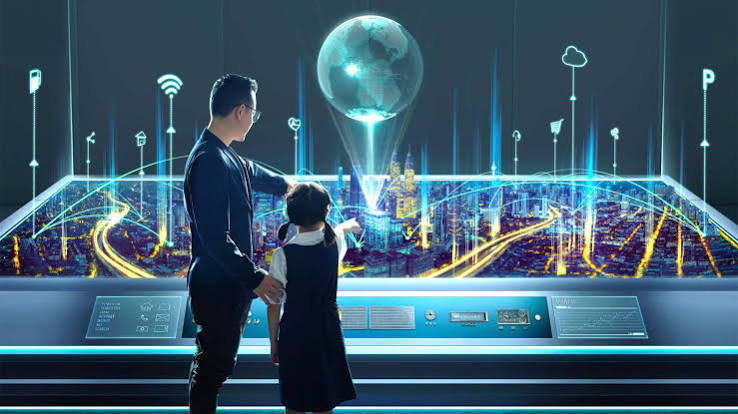
What the Future of the Digital World Could Look Like will depend on how artificial intelligence, faster networks, spatial computing, automation, cybersecurity, and digital identity develop together. The next phase of the internet may feel more personalized, immersive, intelligent, and continuously connected, while placing greater pressure on privacy and trust.
This guide examines directions based on current technology and standards, including AI agents, 6G, quantum-resistant security, mixed reality, smarter devices, digital services, and the challenge of giving more people access.
The Digital Future Will Be an Evolution, Not One Sudden Revolution
Predictions about technology often describe one invention as if it will completely replace everything that came before it.
Real change is usually more complicated.
Smartphones did not eliminate computers. Streaming did not eliminate television. Ecommerce did not eliminate physical stores.
The future digital environment will probably combine existing technologies with newer ones.
Current developments point toward a world where:
- AI performs more tasks on users’ behalf;
- digital services become increasingly personalized;
- physical and digital environments overlap more often;
- networks become faster and more widely available;
- cybersecurity becomes more important;
- human digital skills become increasingly valuable.
Some developments will happen faster than others, and adoption will vary substantially between countries, businesses, and individuals.
Read More: Cybersecurity Basics for Safer Online Browsing
Digital Trends Shaping the Future at a Glance
| Technology | Possible Future Impact | Current Reality |
|---|---|---|
| Artificial intelligence | More autonomous digital assistance | Adoption is expanding rapidly |
| AI agents | Software completing multi-step tasks | Early deployments are growing |
| 6G | Faster, more intelligent connectivity | Standards development underway |
| Satellite connectivity | Broader geographic coverage | Direct-to-device services expanding |
| Spatial computing | Digital information integrated with surroundings | Still developing |
| Smart devices | More connected physical environments | Already widespread |
| Quantum computing | New scientific and computing capabilities | Still developing |
| Post-quantum security | Protection from future quantum threats | Standards available now |
| Digital identity | Easier online verification | Systems remain fragmented |
| Automation | More software-driven workflows | Already transforming many industries |
1. Artificial Intelligence Could Become an Everyday Digital Layer
Artificial intelligence is likely to be one of the most influential forces shaping the digital world.
AI already supports:
- search;
- writing;
- coding;
- image generation;
- customer service;
- data analysis;
- recommendations;
- translation.
Usage is increasing quickly.
The OECD reported in January 2026 that more than one-third of individuals across OECD countries had used generative AI during 2025. Among firms with available data, AI adoption increased from 8.7% in 2023 to 20.2% in 2025.
AI May Become Less Visible
Today, people often deliberately open an AI application and type a request.
Future AI may increasingly operate inside:
- email;
- calendars;
- vehicles;
- operating systems;
- productivity software;
- customer-service systems;
- smart-home devices.
Instead of thinking, “I am using AI,” users may simply use software that happens to include AI.
That would resemble how cloud computing works today. Most users rarely think about the cloud infrastructure behind an application.
2. AI Agents Could Perform More Work on Our Behalf
A chatbot primarily responds to instructions.
An AI agent is designed to go further by completing sequences of actions toward a goal.
Future agents could potentially:
- organize schedules;
- compare services;
- prepare reports;
- coordinate projects;
- search internal company information;
- perform administrative workflows.
The OECD’s 2026 survey of more than 2,000 SMEs across 12 OECD countries found businesses increasingly experimenting with more tailored AI applications, including AI agents, although secure and strategic integration remained uneven. (oecd.org)
Human Oversight Will Still Matter
Giving software more autonomy creates new questions.
Organizations will need to decide:
- what an agent can access;
- what actions require approval;
- how mistakes are detected;
- who is responsible when something goes wrong.
The future may therefore involve supervised autonomy rather than completely independent software.
3. Search Could Become More Conversational
Traditional search relies heavily on entering keywords and opening links.
AI-based search increasingly allows users to ask:
- complex questions;
- follow-up questions;
- comparison requests;
- research questions.
Future search experiences may increasingly combine:
- conventional web results;
- AI-generated summaries;
- maps;
- shopping information;
- video;
- interactive tools.
This could make finding information faster.
However, it also increases the importance of:
- source transparency;
- factual accuracy;
- original publishing;
- verification.
The web still needs credible information for AI systems to retrieve, interpret, and summarize.
4. Personalization Could Become Much More Sophisticated
Current digital platforms already personalize:
- video recommendations;
- advertisements;
- shopping suggestions;
- music playlists.
Future systems may adapt much more deeply to individual users.
A digital service could potentially consider:
- preferences;
- previous interactions;
- goals;
- current context;
- device being used.
Personalization Can Reduce Digital Friction
A learning platform might adjust content to a student’s progress.
A productivity system might prioritize information according to a person’s work.
An online store might present more relevant products.
Privacy Becomes More Important
Personalization often requires information.
Users and regulators will increasingly need to ask:
- What data is being collected?
- Why is it needed?
- How long is it retained?
- Who can access it?
- Can users opt out?
A more personalized internet should not automatically mean unlimited surveillance.
5. The Internet Could Become More Spatial
Most computing currently happens through rectangular screens.
Spatial computing aims to integrate digital information more directly with physical surroundings.
This can involve:
- augmented reality;
- virtual reality;
- mixed reality;
- computer vision;
- wearable displays.
The World Economic Forum describes spatial computing as an emerging approach that combines technologies such as AI, computer vision, and extended reality to blend digital content with physical environments. (weforum.org)
Possible Uses Beyond Entertainment
Spatial computing could influence:
Education: Students could examine interactive 3D models.
Engineering: Designers could inspect virtual prototypes.
Healthcare: Professionals could visualize complex information spatially.
Shopping: Customers could preview products in their homes.
Work: Remote teams could collaborate around three-dimensional information.
Adoption will depend on factors including device comfort, price, battery life, social acceptance, and compelling applications.
6. Screens May Become Less Central
Phones will not necessarily disappear.
However, digital interaction may spread across more surfaces and devices.
Future interfaces could include:
- smart glasses;
- vehicle displays;
- wearable devices;
- voice assistants;
- connected household equipment.
The long-term direction may therefore shift from going online toward being surrounded by digital services that are available when needed.
That could make technology more convenient while making privacy controls more important.
7. 6G Could Create a More Connected Environment
5G deployment is still expanding globally, but work on its successor is already underway.
The International Telecommunication Union refers to the next generation of mobile networks as IMT-2030, commonly called 6G.
In February 2026, ITU experts agreed on draft technical performance requirements for IMT-2030. Proposed usage scenarios include immersive communication, ubiquitous connectivity, AI integrated with communication networks, and integrated sensing and communication. (itu.int)
6G Is Not Just About Download Speed
Future network development may support:
- immersive communication;
- massive numbers of connected devices;
- remote industrial systems;
- integrated sensing;
- AI-native network management.
Commercial adoption will take time.
ITU’s work focuses on IMT-2030, indicating that the next major mobile generation is primarily a development for the end of this decade rather than something most consumers should expect immediately.
8. Satellites Could Reduce Connectivity Gaps
Mobile connectivity traditionally relies heavily on terrestrial cell towers.
Satellite networks are increasingly being integrated with ordinary mobile systems.
ITU reported in April 2026 that direct-to-device satellite systems are progressing toward closer integration with 5G and future 6G standards. The organization describes these networks as potentially helping extend connectivity across remote land, sea, and other poorly served areas. (itu.int)
This Could Change What “No Signal” Means
Future devices may increasingly switch between:
- cellular networks;
- Wi-Fi;
- satellite connectivity.
That could improve access for:
- rural communities;
- emergency responders;
- travelers;
- maritime users.
Coverage does not automatically mean affordable high-speed service, however.
Pricing, device compatibility, regulation, capacity, and local infrastructure will still matter.
9. Billions of People Still Need Better Digital Access
Discussion about AI and 6G can make it sound as if the entire world is already deeply connected.
It is not.
ITU estimates that approximately 6 billion people, or 74% of the global population, were online in 2025, leaving about 2.2 billion people offline. (itu.int)
The gap involves more than network coverage.
Meaningful digital access also depends on:
- affordability;
- connection quality;
- devices;
- digital skills;
- security.
ITU reports that more than 96% of the world’s population is covered by mobile broadband, yet substantial affordability and quality differences remain. (itu.int)
A successful digital future will therefore depend partly on who gets access to new technology, not merely how advanced that technology becomes.
10. Homes Could Become More Context-Aware
Smart homes already contain:
- speakers;
- thermostats;
- lighting;
- cameras;
- appliances.
Future systems may become less dependent on individual commands.
Instead of controlling every device separately, systems could understand broader situations.
For example:
Leaving home could trigger several actions.
The system might:
- adjust temperature;
- turn off lights;
- activate security;
- manage energy use.
The technical capability is only one part of the challenge.
Consumers will also need clear control over:
- microphones;
- cameras;
- activity logs;
- cloud data.
11. Vehicles Will Become More Digital
Cars increasingly combine transportation with software.
Modern vehicles can already include:
- large digital displays;
- connected applications;
- driver assistance;
- over-the-air updates;
- cloud services.
Future vehicles may become even more software-defined.
Software could increasingly manage:
- infotainment;
- battery systems;
- driver assistance;
- navigation;
- personalization.
The ownership experience may therefore begin to resemble owning a connected electronic device as much as a traditional mechanical machine.
That creates new concerns around software support, cybersecurity, subscriptions, and repairability.
12. Work Could Become More Automated
Digital transformation is already changing business processes.
The OECD reports rapid growth in AI adoption among companies, although adoption remains uneven between industries and business sizes. (oecd.org)
Future workplaces may automate more:
- administration;
- document processing;
- scheduling;
- reporting;
- customer support;
- analysis.
Jobs May Change Before They Disappear
Technology often changes tasks within occupations rather than eliminating entire professions at once.
Workers may increasingly use AI as:
- a research assistant;
- drafting tool;
- coding assistant;
- analytical tool;
- workflow coordinator.
Human skills such as judgment, communication, leadership, creativity, and domain expertise may therefore become more valuable alongside technical skills.
13. Digital Skills Will Become More Important
Having internet access alone does not guarantee that people can benefit equally from digital technology.
Future digital participation may increasingly require understanding:
- AI tools;
- privacy;
- cybersecurity;
- data;
- online verification.
The OECD’s 2026 work on skills in the AI age highlights uneven AI adoption and identifies skills as an important factor influencing how effectively individuals and organizations use emerging technology. (oecd.org)
Digital literacy is therefore becoming broader than knowing how to operate a computer.
14. Cybersecurity Could Become More Invisible but More Important
As technology becomes more integrated into everyday life, the number of systems requiring protection increases.
Future cybersecurity will need to cover:
- AI systems;
- smart homes;
- connected cars;
- identity systems;
- cloud services;
- industrial equipment.
Security may increasingly operate automatically in the background.
However, users will still need basic habits such as:
- strong authentication;
- software updates;
- phishing awareness.
A more connected world creates more opportunities but also a larger potential attack surface.
15. Passwords May Gradually Become Less Important
Passwords have long been one of the weakest parts of online security.
They can be:
- reused;
- stolen;
- guessed;
- phished.
Passkeys and other stronger authentication technologies may increasingly replace traditional passwords.
Future authentication could rely more on cryptographic credentials protected through:
- trusted devices;
- biometrics;
- security keys.
This could make logging in easier while reducing certain phishing risks.
Passwords are unlikely to disappear everywhere at once, but the industry is gradually moving toward alternatives.
16. Digital Identity Could Become More Portable
Today, people repeatedly prove who they are to different organizations.
Future digital-identity systems could allow individuals to hold verified credentials and selectively present them when required.
Examples might include proof of:
- age;
- qualification;
- employment;
- licenses.
The important design challenge is ensuring that identity systems improve convenience without creating centralized surveillance.
Users should ideally be able to reveal only the information necessary for a particular transaction.
17. Quantum Computing Could Eventually Change Certain Types of Computing
Quantum computing is frequently discussed as if it will simply replace conventional computers.
That is unlikely.
Quantum systems are being developed for particular categories of problems where quantum mechanics could offer advantages.
Potential research areas include:
- materials;
- chemistry;
- optimization.
Practical large-scale quantum computing remains an evolving field.
The most immediate digital impact is actually cybersecurity preparation.
18. Security Is Already Preparing for Quantum Computers
A sufficiently powerful future quantum computer could break some cryptographic systems protecting today’s digital communications.
That is why organizations are working on post-quantum cryptography before such machines exist.
NIST says organizations should begin migrating to its post-quantum encryption standards now. Three finalized standards are already available for implementation. (nist.gov)
Why Prepare Early?
Cryptography is embedded throughout:
- browsers;
- banking;
- cloud services;
- government systems;
- enterprise software.
Replacing it takes years.
The future of cybersecurity therefore needs to be designed before the future threat fully arrives.
19. Digital Services Could Become More Proactive
Most software currently waits for a user to request something.
Future systems may increasingly anticipate needs.
For example, an assistant might notice that:
- a flight changed;
- a meeting conflicts with another appointment;
- a subscription increased in price.
It could then suggest an action.
With permission, more advanced systems might complete part of that action automatically.
This raises an important design question:
How much control should software have?
Users will need transparent settings and meaningful approval mechanisms.
20. Healthcare Could Become More Digitally Connected
Digital health may increasingly combine:
- wearable sensors;
- remote monitoring;
- telemedicine;
- AI-assisted analysis;
- electronic records.
For some patients, this could mean healthcare becomes more continuous rather than centered entirely around occasional appointments.
A device might track health information over time and identify patterns worth discussing with a professional.
Healthcare is a high-stakes environment, however.
Accuracy, privacy, regulation, security, and clinical oversight remain essential.
21. Education Could Become More Personalized
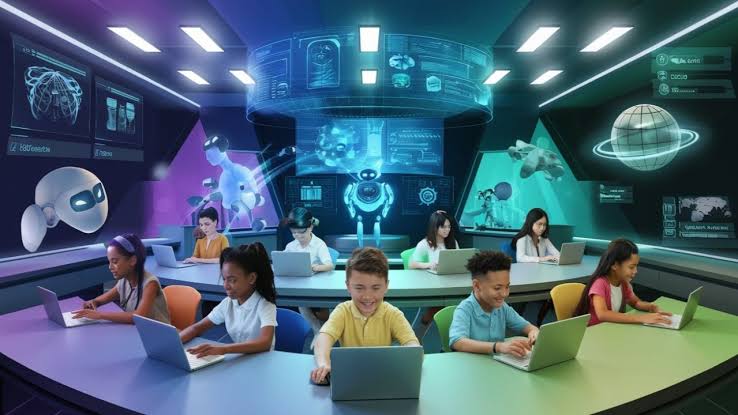
AI may allow educational platforms to adapt explanations and exercises according to individual progress.
Students could potentially receive:
- different examples;
- additional practice;
- immediate feedback.
Teachers could use AI to assist with:
- planning;
- administration;
- creating materials.
The strongest model is unlikely to be “AI instead of teachers.”
Human educators provide:
- motivation;
- judgment;
- social development;
- context.
Technology may become an additional layer around teaching.
22. Entertainment Could Become More Participatory
Digital entertainment has already moved from passive watching toward:
- gaming;
- livestreams;
- creator communities;
- interactive media.
Future entertainment could combine:
- AI-generated elements;
- spatial computing;
- interactive narratives;
- virtual events.
Audiences may increasingly influence or participate in entertainment rather than only watching predetermined content.
That could blur the boundaries between:
- games;
- films;
- social platforms;
- virtual communities.
23. Ecommerce Could Become More Conversational
Online shopping currently involves searching catalogs, comparing products, and navigating filters.
AI shopping assistants may allow consumers to describe needs conversationally.
For example:
I need a lightweight laptop for university, with good battery life, under this budget.
The system could help narrow options according to those requirements.
Future ecommerce may therefore involve less browsing through hundreds of products and more interaction with digital assistants.
Independent verification will remain important because recommendations can be influenced by commercial relationships.
24. Websites May Become More Adaptive
Traditional websites mostly present the same general structure to everyone.
Future sites may become more responsive to context.
A website could potentially alter:
- navigation;
- support;
- recommendations;
- explanations
based on the user’s needs.
This creates convenience but also requires businesses to be transparent about personalization and data collection.
Users should understand when experiences are being modified algorithmically.
25. Privacy Could Become a Bigger Competitive Issue
As digital systems know more about users, companies may increasingly compete on how responsibly they handle data.
Consumers may care about:
- what information is collected;
- whether it is sold;
- how long it is stored;
- whether AI trains on it;
- how easily it can be deleted.
Privacy could therefore become part of product design rather than merely a legal document hidden in a website footer.
26. Regulation Will Help Shape the Digital World
Technology does not develop separately from governments and society.
Future digital policy will influence:
- AI;
- online safety;
- competition;
- telecommunications;
- privacy;
- cybersecurity.
ITU’s 2026 global policy work highlights issues including connectivity, emerging technologies, infrastructure resilience, and digital inclusion as key topics for international cooperation. (itu.int)
Different countries may choose different regulatory approaches.
That could create a digital world that is technologically global but legally fragmented.
27. Sustainability Will Matter More
Digital infrastructure uses significant amounts of:
- electricity;
- hardware;
- data-center capacity.
Future technology development will increasingly need to consider efficiency alongside performance.
ITU’s IMT-2030 principles explicitly include sustainability and energy efficiency among priorities for future 6G network development. (itu.int)
Faster technology is useful.
Faster technology that consumes resources inefficiently may create new problems.
28. Human Trust Could Become the Scarce Digital Resource
Generating content is becoming easier.
AI can create:
- text;
- images;
- audio;
- video.
That means users may increasingly ask:
- Is this real?
- Who created it?
- Can I trust the source?
Authenticity and reputation may therefore become more valuable.
Established organizations, experts, creators, and communities may need stronger ways to prove:
- identity;
- provenance;
- credibility.
The digital future is not only about producing more information.
It is about knowing which information deserves trust.
What Is Most Likely to Change First?
Some trends are much closer than others.
Already Happening
- generative AI;
- AI-assisted work;
- satellite connectivity;
- password alternatives;
- connected vehicles;
- digital entertainment;
- personalized software.
Developing Rapidly
- AI agents;
- spatial computing;
- intelligent automation;
- digital credentials.
Longer-Term
- widespread 6G;
- large-scale quantum computing;
- deeply integrated mixed-reality interfaces.
This distinction matters.
A technology can be technically possible long before it becomes affordable, reliable, socially accepted, and widely adopted.
What Could Slow the Digital Future?
Technological progress does not guarantee universal adoption.
Potential barriers include:
- cost;
- regulation;
- cybersecurity;
- privacy concerns;
- skills shortages;
- infrastructure gaps;
- unreliable technology;
- public resistance.
The OECD’s 2026 SME research, for example, found that time constraints, maintenance costs, and skills gaps continue to limit effective digital technology implementation. (oecd.org)
Technology succeeds when it solves enough problems to justify the effort of adopting it.
How People Can Prepare for the Digital Future
You do not need to predict every technology correctly.
Focus on adaptable skills.
Build AI Literacy
Understand what AI can and cannot do.
Improve Cybersecurity Habits
Use strong authentication and maintain updated devices.
Develop Critical Thinking
Verify important digital information instead of accepting convincing output automatically.
Keep Learning
Technology changes quickly, making continuous learning increasingly valuable.
Protect Personal Data
Understand the privacy settings of services you use.
The ability to adapt may ultimately matter more than expertise in any one platform.
Frequently Asked Questions
What will the digital world look like in the future?
It is likely to become more AI-assisted, connected, personalized, immersive, and automated. However, the exact outcome will depend on infrastructure, affordability, regulation, cybersecurity, and user acceptance.
Will AI become part of everyday life?
It already is for many people. OECD data published in 2026 showed that more than one-third of individuals across OECD countries had used generative AI during 2025, although adoption differs substantially across groups and countries.
When will 6G become available?
ITU is developing IMT-2030 standards for 6G, with technical performance requirements progressing during 2026. The name itself reflects an industry direction toward around 2030 rather than immediate mass adoption.
Will virtual reality replace smartphones?
There is no strong basis for assuming that. Spatial computing may complement phones, computers, and wearables rather than replacing every existing interface.
Will passwords disappear?
Passwords may become less important as passkeys and other cryptographic authentication systems expand. A complete global transition would take time because older systems will continue supporting passwords.
How could quantum computing affect the internet?
A sufficiently powerful quantum computer could eventually threaten some cryptography used today. NIST has already finalized post-quantum security standards and recommends beginning migration before that threat becomes practical.
Will everyone eventually have internet access?
Connectivity continues expanding, but universal meaningful access has not been achieved. ITU estimated that 2.2 billion people remained offline in 2025, with affordability, infrastructure, skills, and quality continuing to create barriers.
What is the biggest challenge facing the future digital world?
There is no single challenge. Major issues include cybersecurity, privacy, unequal access, digital skills, misinformation, sustainability, and ensuring increasingly autonomous systems remain accountable to people.
Conclusion
What the Future of the Digital World Could Look Like is becoming clearer as AI, next-generation connectivity, spatial computing, automation, digital identity, and stronger cybersecurity develop together. Digital services are likely to become more intelligent, personalized, connected, and integrated with everyday environments.
